
A professional driving school teaches learners vehicle mechanics, proactive hazard perception, and road safety regulations required to pass a practical driving test. Professional training replaces guesswork with repeatable driving routines through structured, dual-control car sessions. Working with an experienced driving instructor builds the spatial awareness, scanning habits, and decision-making skills needed for lifelong solo driving.
What Does a Professional Driving School Teach?
Learning to drive safely requires far more than keeping a vehicle between road lines. Systematic driver education breaks down road use into manageable competencies, beginning before the ignition turns on.
Every initial session begins with a structured cockpit drill. Proper seating posture ensures your wrists rest comfortably over the top of the steering wheel without your shoulders lifting off the backrest. Your right heel rests firmly on the floor pan in front of the footbrake, pivoting across to the accelerator pedal, while your left foot remains steady on the footrest. Mirror adjustment requires positioning the interior rear-view mirror to frame the back window completely, then adjusting side mirrors outward until your own car panels occupy only a thin sliver of the inner glass edge.
Core vehicle setup steps
- Doors and seat distance: Secure all doors, then slide the seat base so your knees retain a slight bend when depressing pedals fully.
- Backrest angle and steering reach: Adjust the seat rake so your arms remain relaxed with bent elbows.
- Head restraint positioning: Align the centre of the headrest level with eye height.
- Mirror alignment: Minimize blind spots across both flanks while maintaining clear rear visibility.
- Seatbelt engagement: Fasten low across the hips and flat across the collarbone.
Once cabin setup becomes second nature, training advances to fine vehicle control. Beginners frequently struggle with abrupt braking and erratic steering inputs. Structured coaching teaches progressive braking by applying light pressure initially, increasing firm pressure through the middle of the stop, and easing pedal resistance slightly right before halting to eliminate forward inertia.
Hazard perception develops as an active physical habit rather than a purely theoretical exercise. Instructors teach a continuous observation cycle to maintain road awareness:
- Check interior and side mirrors every few seconds and prior to any deceleration.
- Scan cross-streets from right to left before entering any intersection.
- Direct your visual focus well down the road to identify stationary delivery vans, opening car doors, and pedestrian activity early.
Why dual-control training vehicles protect beginners
Dual-control cars feature an auxiliary brake pedal installed on the passenger side where the instructor sits. This mechanical linkage allows immediate physical intervention if a learner misjudges a gap, approaches a roundabout too fast, or fails to notice a sudden stop ahead.
For a new learner driver, having this physical safeguard removes high levels of performance anxiety. Knowing an experienced professional can halt the vehicle drops mental fatigue, allowing you to build coordination and spatial judgment in real traffic conditions instead of staying trapped in empty car parks.
| Training Factor | Informal Family Practice | Professional Driving School |
|---|---|---|
| Emergency Intervention | Limited to verbal alerts or handbrake reach | Direct passenger-side footbrake control |
| Lesson Progression | Ad-hoc routes based on household errands | Structured syllabus targeting specific driving competencies |
| Feedback Quality | Subjective, based on personal driving habits | Objective, based on testing standards |
| Traffic Exposure | Familiar local suburban backstreets | Diverse multi-lane roads, complex intersections, and test zones |
Structured Lessons vs. Casual Practice: How Driving School Works
Supervised driving with family members offers valuable log book hours, yet it often passes down personal driving shortcuts. A driving school delivers methodical training designed to build correct road habits from the ground up.
Professional instructors assess road positioning, mirror routines, and speed control against strict testing guidelines. Informal supervisors often overlook rolling stops at stop signs, late indicator signals, or one-handed steering habits. During formal driving lessons, an instructor corrects these issues immediately. You learn that a stop sign demands total wheel cessation behind the marked line, and that turning signals must operate continuously for adequate duration before moving away from a kerb.
Structured lessons also maximize the educational value of early log book entries. Rather than spending dozens of hours driving in straight lines on quiet motorways, learners encounter varied, challenging environments under guidance:
- High-density shopping precincts with heavy pedestrian foot traffic.
- Multi-lane roundabouts requiring quick lane discipline and exit signalling.
- School zones with reduced speed thresholds during morning and afternoon drop-offs.
- Uncontrolled intersections requiring careful gap selection and clear vision lines.
Confronting these environments under expert supervision stops bad habits such as tailgating, poor lane tracking, and skipped blind-spot shoulder checks before they become fixed routines.
Core Manoeuvres You Master in Professional Lessons
Practical driving tests assess low-speed vehicle placement and spatial control. Professional lessons break complex parking and turning manoeuvres down into reliable, reference-based steps.
1. Kerbside stops and smooth hill starts
Executing a clean kerbside stop requires checking the rear-view mirror, checking the left mirror, signalling left, and gliding parallel to the gutter without brushing the concrete. On steep inclines, hill start training focuses on coordinating pedal release and accelerator balance to prevent any roll-back.
2. The three-point turn
Practised on quiet suburban streets, the three-point turn evaluates vehicle control, steering speed, and 360-degree environmental observation:
- Signal left to bring the vehicle parallel to the kerb, then cancel the indicator.
- Check mirrors, signal right for several seconds, and conduct a thorough over-the-shoulder blind-spot check.
- Move across the roadway toward the opposite gutter while turning the steering wheel briskly to full lock, stopping before the kerb.
- Shift into reverse, check both directions along with rear blind spots, and reverse while steering toward the opposite direction.
- Select drive, re-check road traffic in both directions, and complete the turn smoothly into your travelling lane.
3. Reverse parallel parking
Parallel parking creates anxiety for many learners because it demands precise spatial judgment and continuous blind-spot awareness. Instructors teach clear visual markers to take out the guesswork:
- Pull alongside the reference vehicle, leaving roughly one metre of lateral clearance, with rear bumpers aligned.
- Select reverse and execute a full 360-degree visual scan before moving.
- Reverse straight until your rear wheels align with the back corner of the neighbouring vehicle, then turn full lock toward the kerb.
- Straighten the steering wheel as the car enters a 45-degree angle to the kerb, rolling into the parking space.
- Lock the steering in the opposite direction to swing the front nose inward, finishing parallel to the gutter within the parking bay.
4. Navigating complex roundabouts
Roundabouts require clear lane choice and calm decision-making in moving traffic. Training focuses on correct lane entry positioning, giving way to circulating vehicles on your right, and signalling your exit without unsettling vehicle stability.
Approaching to turn left means selecting the left lane, indicating left early, yielding right, and keeping the indicator on until the exit is cleared. Going straight through generally requires no indicator on entry while maintaining your lane, followed by a left exit signal once you pass the first intermediate turn. Turning right or making a U-turn demands entering in the right lane with a right signal active, maintaining position around the central island, and switching to a left indicator after passing the exit before yours.
Standard Progression Model:
Quiet Residential Streets -> Suburban Arterials -> Multi-lane Intersections -> High-Speed Merging & Mock Tests
Professional coaching introduces these technical manoeuvres in low-density residential streets where you can focus on mechanical coordination without trailing traffic. Once reference points and mirror checks become automatic, training shifts into real-world settings with active traffic, parked vehicles, and varying road slopes.
How to Choose the Right Driving School and Instructor
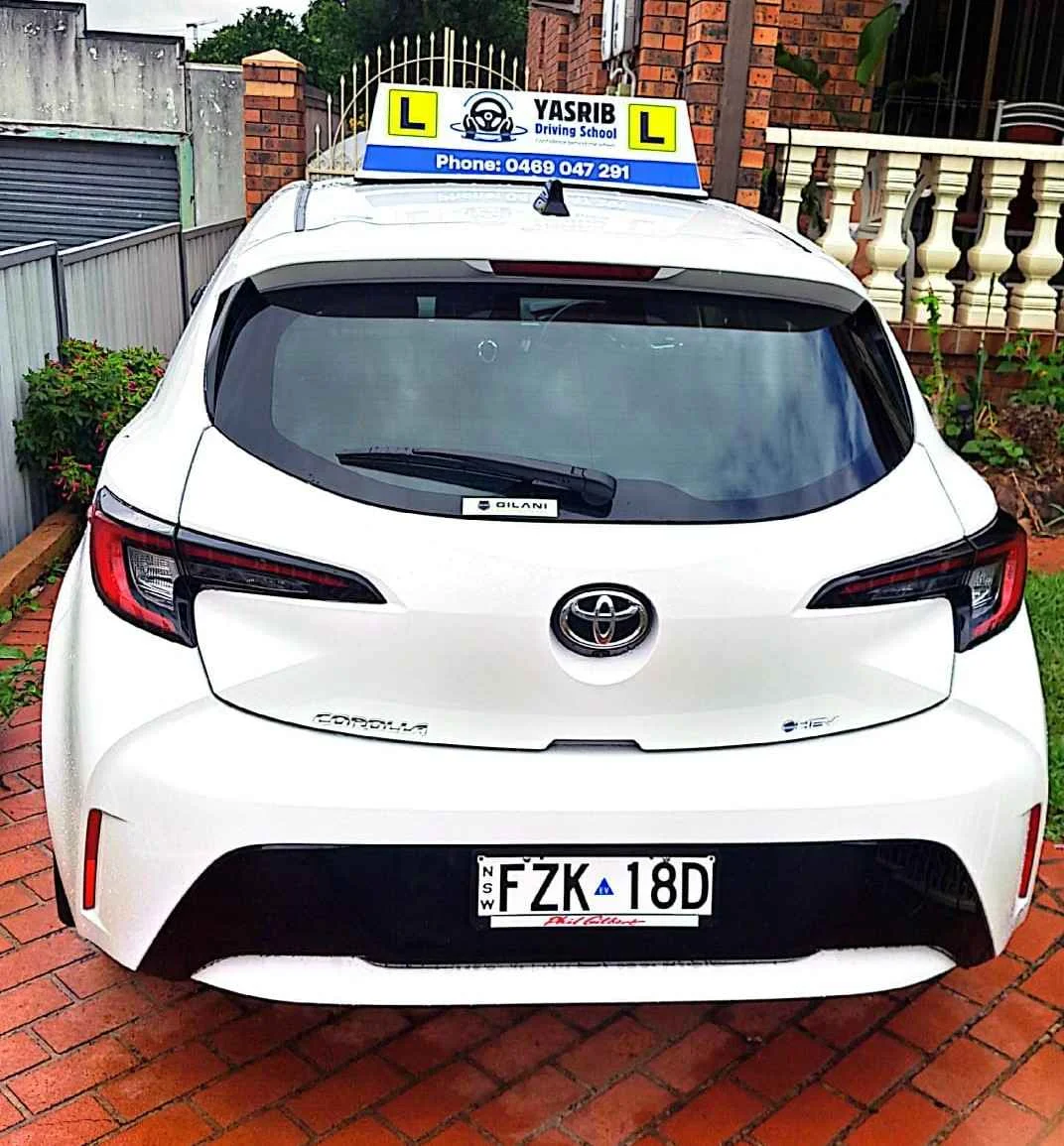
Finding the right instructor sets the tone for your entire learning journey. A high-quality driving school pairs patient communication with modern, dual-control training vehicles and deep familiarity with regional testing routes.
Key evaluation criteria to consider:
- Experienced instruction: Choose instructors who understand local testing routes, assessment score sheets, and common learner mistakes.
- Dedicated training fleet: Ensure vehicles feature passenger-side dual brake controls, dual mirrors, and regular maintenance.
- Multilingual teaching capabilities: Learning road safety rules in your primary language removes communication barriers and lowers stress during early sessions.
- Structured syllabus: Lessons should track concrete milestones rather than aimless driving around suburban blocks.
Yasrib Driving School provides 1 hr beginners Lesson, 1.5 hr beginners Lesson, 6 hr beginners Lesson for Beginner drivers, learner drivers needing log book hours, and overseas licence holders converting to an Australian NSW licence in Merrylands, Parramatta, Lidcombe, Blacktown, and surrounding areas.
Watch out for clear red flags when evaluating instructors. Avoid trainers who check mobile phones during lessons, shout when mistakes happen, or fail to explain the mechanical reason behind an error. Quality instructors stay attentive, provide calm feedback, and structure each session around progressive skill mastery.
Lesson Formats: From First-Time Beginners to Test Preparation
Driver training is not a one-size-fits-all process. Session structures match different stages of learning, from initial car control to fine-tuning test readiness.
1-Hour targeted driving lessons
Short single-hour sessions work well for beginner car control drills, steering technique refinement, or isolated practice on specific parking manoeuvres. This format delivers focused learning without overwhelming early learners with mental fatigue.
1.5-Hour extended lessons
Extended sessions provide the ideal timeframe for intermediate drivers. They provide enough road time to travel beyond local streets, tackle multi-lane arterial roads, practise higher-speed merging, and explore regional testing routes without rushing.
Overseas licence conversion training
Experienced international drivers moving to Australia often possess years of driving history in their home countries. However, local road rules and testing expectations frequently differ from overseas driving environments:
- Roundabout give-way priorities and multi-lane markings.
- School zone speed limit rules and designated operational times.
- Lane discipline when navigating complex traffic light intersections.
- Mandatory physical over-the-shoulder blind spot checks before any lane change or merge.
Targeted conversion sessions help overseas licence holders adapt quickly, unlearning reflexive driving habits that lead to automatic test fails under local assessment criteria.
Simulated mock driving tests
Completing a realistic mock exam before sitting your practical driving assessment provides an accurate benchmark of test readiness. Your instructor takes you through an authentic testing route while scoring your driving under exam conditions.
During the mock test, the instructor does not provide driving advice, reminders, or prompts. They record both minor driving faults and critical errors such as failing to give way or exceeding speed thresholds. A thorough debrief afterwards identifies precise weak spots so you can correct them before your official test day.
Frequently Asked Questions
How much does driving school cost?
Driving lesson pricing varies based on session length and booking structure. Pay-as-you-go hourly options typically start from $59 per hour, while 1.5-hour sessions and structured multi-lesson packages offer cost-effective options for learners seeking comprehensive log book progression and test preparation.
How do I spot a bad driving instructor?
Warning signs include poor punctuality, an unmaintained vehicle lacking dual controls, inattentive supervision, or checking personal phones during lessons. A poor instructor often yells or criticises errors without explaining the underlying mechanical or positional reason, leaving the student anxious rather than skilled.
Can overseas licence holders take lessons before sitting the NSW test?
Yes. Taking professional lessons is strongly recommended for overseas drivers. Conversion lessons help experienced drivers adapt to Australian road rules, give-way laws, roundabout rules, and the strict blind-spot checking procedures assessed by local testing officers.


